
Looking up: Living in the Aerial Age

For most of human history, our awareness of the world has been only horizontal.
We watched the ground beneath our feet for food, shelter, and safety. Farmers looked to the soil. Travelers studied the terrain. Sailors scanned the horizon. Occasionally we glanced upward to the clouds, to judge the weather, or the stars, to find our way.
But the sky itself was mostly empty to us.
Today, that is no longer true.
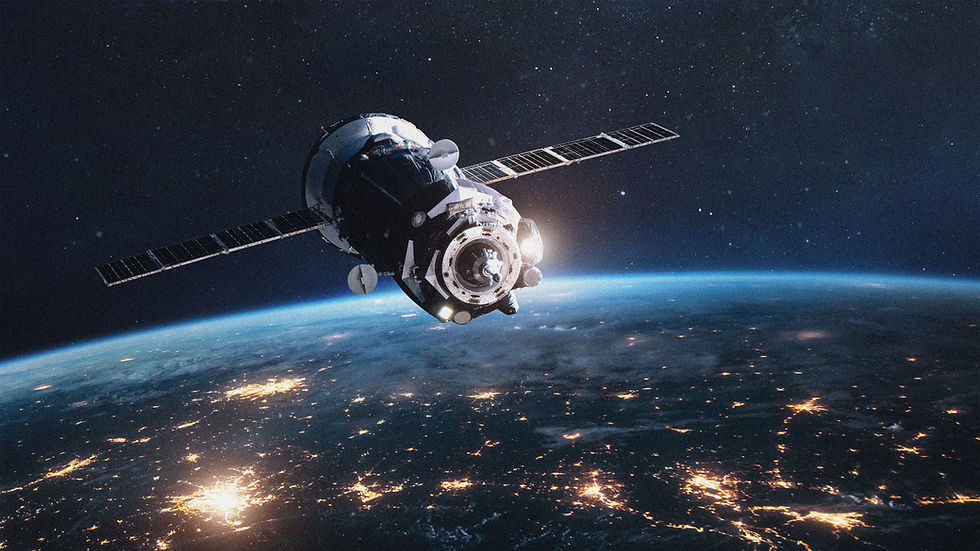
Above the clouds, far beyond the reach of everyday sight, humanity has quietly built a second infrastructure, one that floats silently over every ocean, desert, forest, and city.
Thousands of satellites circle the Earth now, moving in carefully choreographed paths. Some are visible for a brief moment as a streak of light at dusk. Most pass by entirely unnoticed.
Yet they are always up there.
We have entered a new era: the age of the aerial.
A century ago, the idea that machines could orbit the planet was science fiction. The launch of Sputnik in 1957 marked the beginning of an era of aerial growth that has unfolded steadily ever since. What began as a handful of experimental objects has evolved into a vast network that touches nearly every part of modern life.
Navigation systems guide our vehicles through cities and across oceans using GPS. Weather satellites track storms before they form into disasters. Communications satellites beam television, data, and internet connectivity across continents. Commercial imaging satellites capture pictures of Earth with astonishing clarity. Defense satellites watch borders, oceans, and launch sites- all from afar above.
And perhaps most remarkably, this network operates largely out of sight and out of mind. We walk through our daily routines-checking our phones, navigating roads, streaming information-rarely pausing to consider that many of these interactions depend on machines, engines, flying hundreds of thousands of miles above us.
Our mental map of the world still tends to be two-dimensional.
We think about streets, buildings, coastlines, and landscpaes. But above that familiar world exists an entire layer of technology. Satellites occupy orbital highways, each path carefully calculated to maintain coverage, avoid collissions, and deliver signals across the globe.
Above every city is an invisible choreographed architecture.
Above every ocean is a web of observation.
Above every nation is a quiet presence of machines that see, listen, relay, and measure.
This shift represents more than a technological milestone-it is a change in milieu.
A new era.
For most generations before us, awareness of the sky meant awareness of nature: clouds gathering on the horizon, the arc of the sun, the phases of the moon. Today, the sky contains not only natural forces but human systems-designed, launched, and operated by governments and companies around the globe.
The aerial domain has become an extension of civilization.
Companies are now building massive satellite constellations designed to blanket the planet with connectivity. Among the most visible is Starlink, operated by SpceX, which has already placed thousands of satellites into orbit. Similar initiatives are emerging globally, from telecommunications to Earth observation networks.
The sky is becoming busy.
In fact, when you step outside at twilight in a dark area, you may see a chain of moving lights crossing the sky-satellites reflecting sunlight as they pass over the skies. What looks like a quiet celestial procession is actually a glimpse into an expanding technological ecosystem.
Yet actually, it's a rhyzome of a precession of the sun that we have not fully absorbed yet.
We walk, drive, build, and communicate with little awareness that above us exists a constant layer of sensing, imaging, navigation, and combustion of electricity and waves.
We are contained from above.'
Perhaps the next shift in awareness will come not from technology itself, but from perspective.
Just as previous generations learned to read landscapes and weather patterns, our generation may begin to develop a new aerial awareness, one that includes the orbital environment. The sky is no longer only atmosphere and stars; it is also a network of node connecting nodes.


Comments